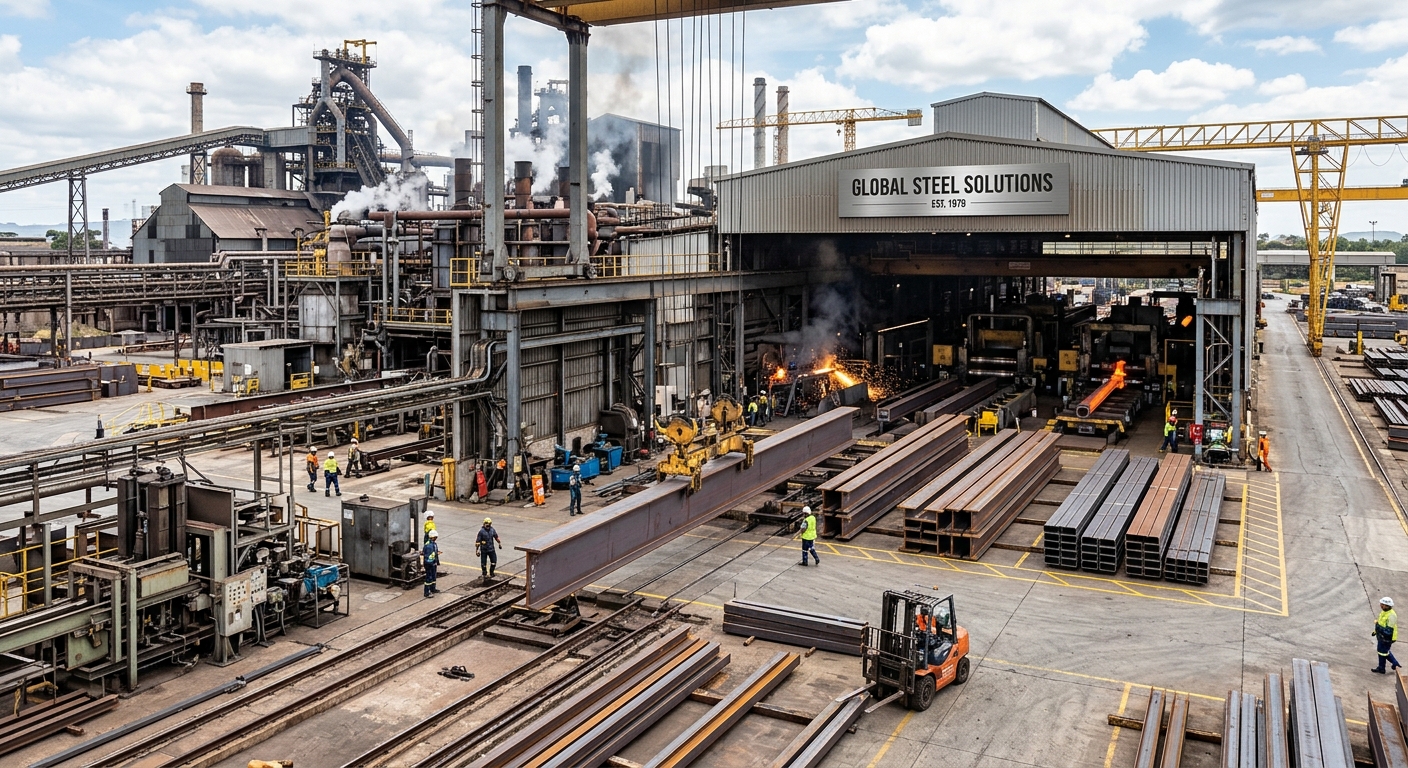
Executing large-scale infrastructure, commercial construction, and industrial manufacturing projects requires reliable access to high-capacity steel production and certified material standards. Through our trusted HPC partner network, international developers, contractors, and industrial enterprises gain direct access to world-class steel manufacturing capabilities, covering a massive annual production capacity backed by rigorous global certifications.
Comprehensive Steel Hollow Sections and Structural Tubing
Advanced architectural and engineering projects demand precision-formed structural tubing capable of supporting extreme loads across diverse environments.
Full-scale square and rectangular steel hollow sections are produced in specialized mills, providing superior load-bearing strength for iconic architectural structures, sports stadiums, and transportation hubs.
High-frequency electric resistance welded (ERW) round pipes and heavy-duty submerged arc welded (LSAW and SSAW) pipes offer robust solutions for large-scale fluid transport and structural piling.
Specialized right-angle steel tubes and heat-treated structural components deliver exact dimensional tolerances and enhanced internal stress relief for complex engineering designs.
Advanced Corrosion-Resistant ZMA Coatings and Coils
Protecting infrastructure against severe environmental exposure is essential for maximizing asset lifespan in coastal, industrial, and high-moisture locations.
Zinc-aluminium-magnesium (ZMA) alloy-coated steel coils provide exceptional sacrificial and barrier corrosion resistance, significantly outperforming traditional galvanization.
Innovative self-healing cutting surfaces form dense protective films over exposed edges automatically over time, inhibiting rust and chemical degradation.
Lightweight design capabilities eliminate the need for costly structural roof reinforcement when deploying photovoltaic solar mounting systems and industrial storage racks.
Specialized Profile Steel and Renewable Energy Stents
Supporting modern industrial fabrication requires a versatile inventory of standard and customized profile shapes engineered for rapid on-site assembly.
Hot-rolled H beams, equilateral and unequal angle bars, channel bars, and steel flat bars provide foundational integrity for building frames, bridges, and ship construction.
Precision cold-bent C purlins and U, Z, and W steel sheet piles offer versatile structural support for wall framing, retaining barriers, and lightweight building trusses.
Pre-drilled solar mounting brackets and ground screw piles come ready for fast deployment across challenging terrain types including deserts, rooftops, and agricultural ponds.
Frequently Asked Questions (FAQs)
1. How can Algeria businesses access high-capacity structural steel manufacturing?
Algeria businesses gain direct access to world-class steel manufacturing capabilities with an annual production capacity of 10 million tons through our trusted HPC partner network.
2. What types of steel hollow sections are available for construction projects in Algeria?
Our network supplies full-scale square, rectangular, and round steel hollow sections manufactured to support iconic architectural and structural engineering projects.
3. How do square and rectangular tubes benefit large-scale developments in Algeria?
Medium-thick wall square and rectangular tubes provide superior load-bearing strength and stability for sports stadiums, transportation hubs, and commercial towers.
4. What quality standards and certifications back the structural steel supplied to Algeria?
Products comply with rigorous international benchmarks, including ISO 9001, ISO 14001, CE EN10219, and EN10210 certifications.
5. How are round pipes manufactured for fluid transport and piling in Algeria?
Round pipes are produced via high-frequency electric resistance welded (ERW), double-sided submerged arc welded (LSAW), and spiral welded (SSAW) processes.
6. What dimensional ranges are covered for LSAW round pipes in Algeria projects?
LSAW round pipes are available in custom-guaranteed diameters ranging from 406mm to 1420mm with wall thicknesses reaching up to 50mm.
7. Can spiral welded (SSAW) pipes handle large infrastructure demands in Algeria?
Yes, SSAW production lines manufacture pipes ranging from 219mm up to 3600mm in diameter, ideal for major civil engineering and piling applications.
8. What advantages do right-angle steel tubes offer mechanical designers in Algeria?
Right-angle steel tubes deliver exact dimensional tolerances, tight R corners, and enhanced straightness for complex structural frameworks.
9. How does heat treatment improve structural steel performance for Algeria firms?
Preliminary normalizing and annealing processes refine grain structures, relieve internal stresses, and enhance overall steel toughness for batch structural processing.
10. What corrosion-resistant materials are available for harsh environments in Algeria?
Zinc-aluminium-magnesium (ZMA) alloy-coated steel coils and pipes provide exceptional sacrificial and barrier corrosion protection in aggressive or coastal climates.
11. How does the self-healing function work on ZMA steel cutting surfaces in Algeria?
Over time, coating components near cut sections dissolve to form a dense protective film of zinc and magnesium hydroxides that actively inhibits edge corrosion.
12. Why are ZMA steel products ideal for lightweight construction in Algeria?
ZMA coatings reduce the overall weight of steel components without sacrificing durability, eliminating the need for costly roof reinforcement during installations.
13. What warranty protection covers ZMA steel coils deployed in Algeria?
Advanced ZMA coils feature long-term product warranties guaranteeing structural integrity against red rust and perforation across various ISO corrosion categories.
14. What profile steel shapes can Algeria contractors procure through the network?
Contractors can source hot-rolled H beams, equilateral and unequal angle bars, channel bars, and steel flat bars for diverse construction needs.
15. How are C purlins utilized in building construction across Algeria?
Cold-bent C purlins serve as roof purlins and wall beams, and can be combined into lightweight building trusses, brackets, and structural framing components.
16. What application uses do U, Z, and W steel sheet piles serve in Algeria?
Steel sheet piles feature edge linkages that lock together freely to form continuous, secure retaining walls for soil and water control projects.
17. Are solar mounting structures pre-fabricated for rapid assembly in Algeria?
Yes, solar mounting brackets and ground screw piles come with cutting and drilling completed prior to factory dispatch for fast on-site installation.
18. What coating types protect photovoltaic solar stents deployed in Algeria?
Solar mounting structures utilize hot-dip galvanized steel or advanced ZMA coatings designed to withstand harsh desert, rooftop, or coastal conditions.
19. How do pickled and oiled (PO) coils assist manufacturing plants in Algeria?
PO coils serve as premium intermediate products with oxidized layers removed, making them ideal for cold roll forming and stamping operations.
20. What role do cold-rolled steel coils play in Algeria industrial fabrication?
Cold-rolled coils are easily stamped and coated to manufacture household appliance housings, automotive sheet metal, and metallic building materials.
21. How does the HPC partner network streamline procurement for Algeria enterprises?
The network provides a single point of coordination, bridging international buyers with tier-one manufacturing capacity and verified quality assurance.
22. Can Algeria developers request customized structural steel specifications?
Yes, manufacturing partners offer tailored structural designs, customized dimensions, and specific grade alignments based on project engineering drawings.
23. What steel grades are standard for structural hollow sections supplied to Algeria?
Standard grades include ASTM A500, CSA G40.21, EN10219, EN10210, and AS/NZS 1163, accommodating diverse international engineering codes.
24. How do hot-dip galvanized post-treatments protect steel pipes in Algeria?
Post-processing hot-dip galvanizing complies with standards like BS1387 and ASTM A123, adding robust surface protection against atmospheric corrosion.
25. What measures ensure complete traceability for steel shipments delivered to Algeria?
Shipments include mill test certificates, contract tracking numbers, coil identification numbers, and original quality inspection documentation.
26. How do flat steel products support industrial manufacturing in Algeria?
Flat steel with rectangular cross-sections is used to manufacture hoop iron, tools, mechanical components, escalators, and laminated rolled sheet bars.
27. What structural advantages do serrated flat bars offer Algeria builders?
Serrated flat bars and I-bars provide enhanced anti-slip safety surfaces widely utilized in industrial ladder rungs, platforms, and flooring walkways.
28. How are twist steel bars applied in Algeria construction projects?
Twist steel bars provide high-tensile reinforcement and structural detailing for specialized architectural and heavy engineering applications.
29. What scale of international projects has the manufacturing network previously supported?
The network has successfully supplied cooperative production solutions for over 6,000 major global projects, including iconic stadia and airports.
30. How do square bars support automotive and machinery sectors in Algeria?
Hot-rolled and cold-drawn square bars ranging from 5mm to 150mm provide reliable raw material stock for auto parts, ship components, and machinery.
31. What environmental benefits are integrated into the steel production process?
Advanced acid regeneration systems recycle heavy metals like chromium and nickel while significantly reducing acid consumption and wastewater treatment costs.
32. Can Algeria firms source steel suitable for offshore and marine environments?
Yes, specialized ZMA coatings and DNV-certified LSAW pipes offer exceptional resistance to marine salt spray and high-moisture degradation.
33. What length options are available for profile steel products shipped to Algeria?
Profile bars such as angle bars, channel bars, and flat bars are supplied in standard 6m, 9m, and 12m lengths, or customized to project specifications.
34. How does the supply chain handle non-compliant products during manufacturing?
Strict quality control workflows isolate non-compliant steel items into designated holding warehouses to ensure only certified materials reach Algeria clients.
35. What testing procedures verify the weld integrity of pipes supplied to Algeria?
Pipes undergo ultrasonic testing (UT), X-ray inspection, hydrostatic pressure testing, and destructive laboratory analysis to guarantee structural safety.
36. How do channel bars contribute to curtain wall engineering in Algeria?
Channel bars provide sturdy structural framing for building facades, curtain wall engineering, and vehicular frame manufacturing.
37. What thickness range is supported for heavy industrial angle bars?
Hot-rolled angle bars are available in thicknesses ranging from 1mm up to 25.4mm with widths between 15mm and 250mm for robust structural framing.
38. How do round-to-square hollow sections achieve their unique profile?
Non-standard tubes use large LSAW or seamless pipes as raw materials, re-extruding them into customized square or polygonal shapes with optional hot finishing.
39. What maximum dimensions are achievable for round-to-square structural tubes?
Advanced manufacturing mills can produce massive round-to-square sections up to 1500mm x 1500mm with wall thicknesses reaching 80mm.
40. How do anti-corrosion properties of ZMA compare to traditional pre-galvanized pipes?
ZMA pipes withstand hundreds of hours of salt spray testing significantly longer than standard pre-galvanized alternatives before showing red rust formation.
41. What temperature limitations apply to ZMA steel structures in Algeria?
ZMA structural elements maintain optimal performance provided operational service temperatures do not permanently exceed 100 degrees Celsius.
42. How does the HPC partner network assist with logistics for Algeria projects?
The network coordinates seamless export documentation, packaging security, container loading, and international freight delivery schedules.
43. What structural standards govern H beam production for heavy construction?
H beams are manufactured to meet global executive standards including GB, JIS, ASTM, and EN requirements, with flange thicknesses up to 35mm.
44. Can Algeria infrastructure projects utilize earthquake-resistant steel grades?
Yes, high-strength low alloy (HSLA) steels and seismic-rated grades provide superior ductility and energy absorption capacity for high-risk seismic zones.
45. What surface finishes are available for architectural hollow sections?
Options include black un-coated finishes, oiled surfaces, spray-painted coatings, hot-dip galvanizing, and advanced ZMA protective layers.
46. How do square and rectangular tubes optimize architectural aesthetics?
Clean right angles, precise corner radii, and uniform dimensions allow architects to expose structural steel elements as clean visual design features.
47. What technical support is provided to Algeria engineers during project planning?
Our technical advisory team assists with material selection, span calculations, load-bearing analysis, and compliance verification for specific regional building codes.
48. How are steel bundles secured for long-distance international shipping?
Products are tightly bound with heavy-duty steel strapping, edge protectors, and weather-resistant wrapping to prevent transit damage during ocean freight.
49. What minimum coating weights apply to high-durability ZMA specifications?
High-durability classifications feature coating weights ranging from 180 g/m2 up to 600 g/m2 across both sides to match severe C5 environmental exposure categories.
50. How can Algeria business leaders initiate a structural steel supply consultation?
Leaders can outline their project requirements, tonnage needs, and delivery schedules to our HPC partner network to receive a tailored commercial proposal.
Let’s start a conversation
Let’s find the right next step for you.
Share your questions and goals. Our team will help you explore the support and opportunities available.